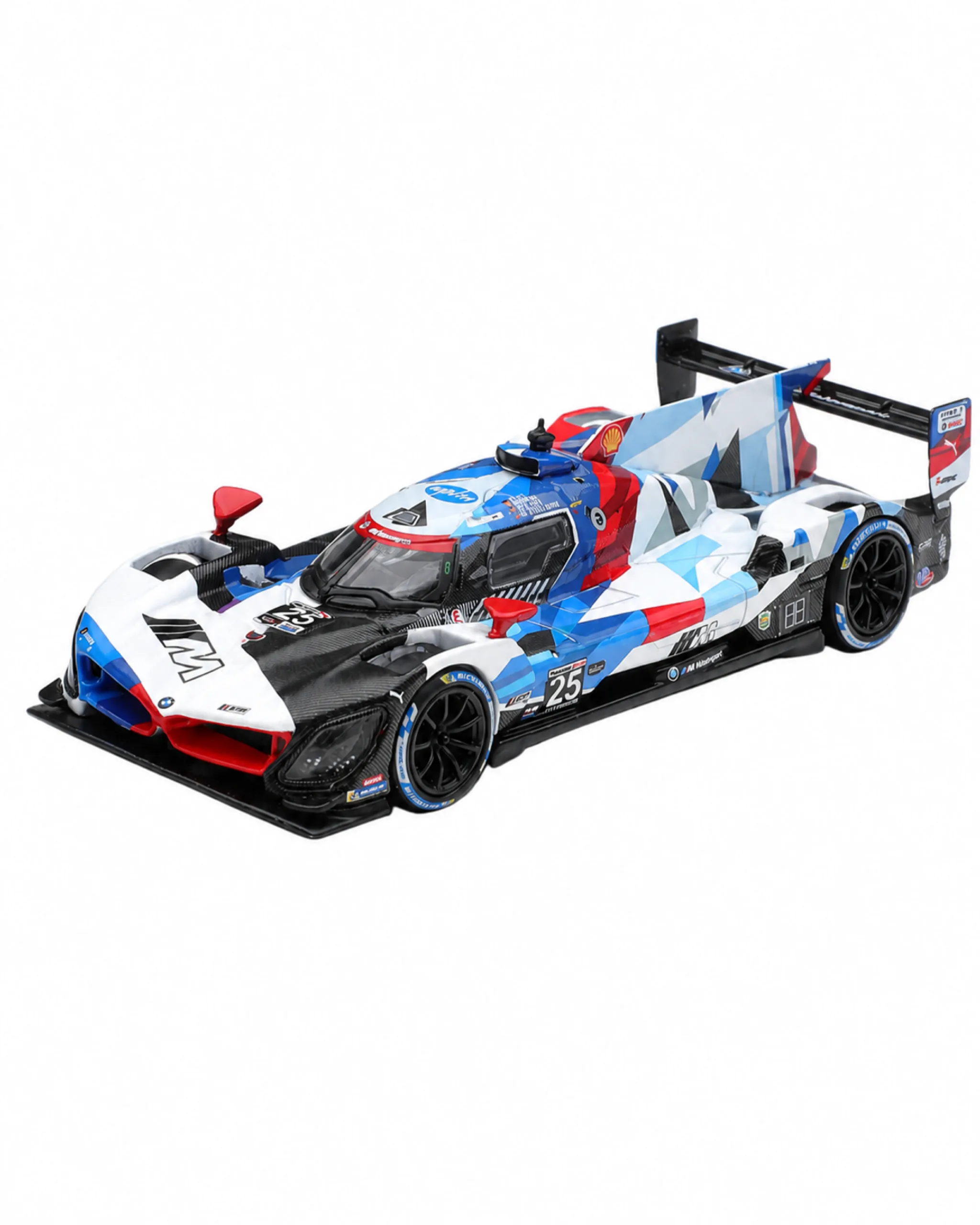
 Main view
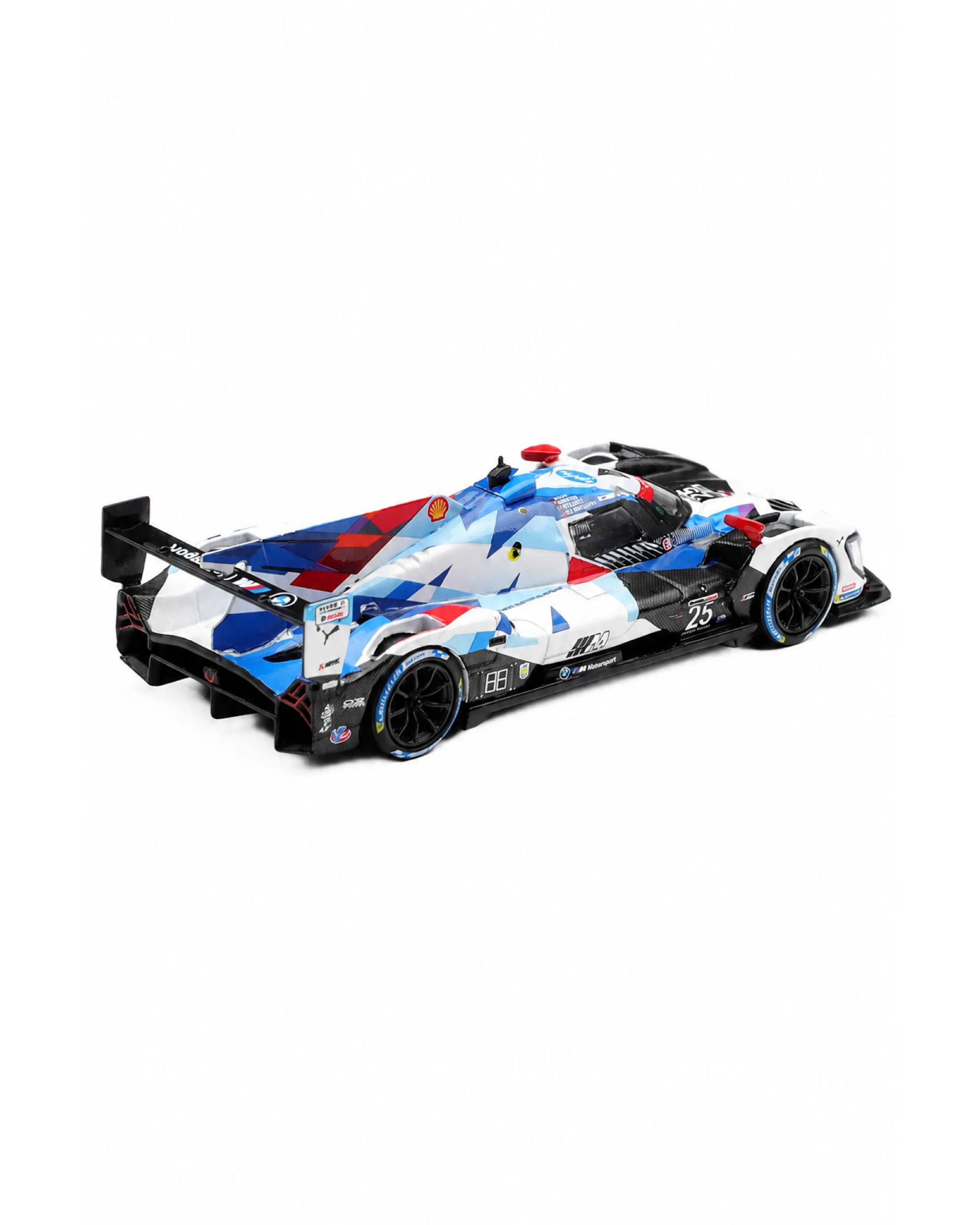 Angle 2
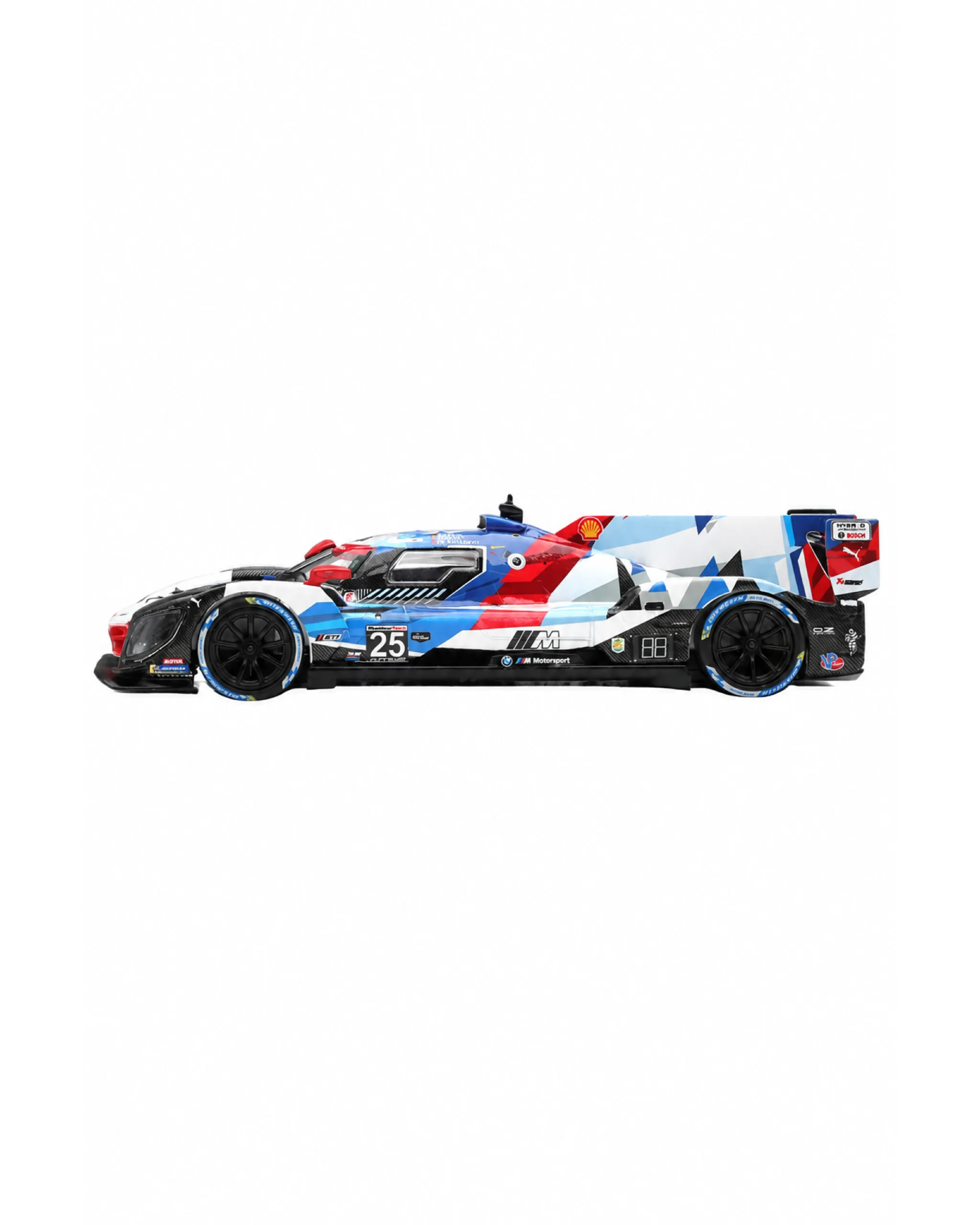 Angle 3
MINI GT BMW V8 GTP #1241 1/64 Diecast Model
A 1/64 MINI GT BMW V8 GTP in an angular white, blue and red wrap over exposed carbon, a roughly 7 cm static diecast model for 1/64 pit-lane and garage scenes.
It measures roughly 7.2 cm nose to tail at 1/64, a shade over 2 cm tall to the top of the wing endplates, and it is a static diecast model with fixed panels and rolling wheels. The real car is a little over 5 m, which is where that length comes from.
Available from NXSTUDIO — an independent retailer of 1/64 diecast model cars from established brands, with full product specifications, protective packaging, and tracked worldwide shipping.
About this model
A hybrid prototype is a strange thing to make small. The body is one long shell, the canopy is a bubble in the middle of it, and the tail runs on well past where a normal car would stop. There is no boot lid, no rear window and no obvious place for the shape to end — it just tapers and stops, under a wing that sits higher than the roof. Reproducing that at 1/64 means casting a shape with very few features to hold on to, and this BMW V8 GTP casting handles it by leaning on the livery instead.
It measures roughly 7.2 cm nose to tail at 1/64, a shade over 2 cm tall to the top of the wing endplates, and it is a static diecast model with fixed panels and rolling wheels. The real car is a little over 5 m, which is where that length comes from.
A geometric wrap in white, blue and red, with carbon underneath
The paint scheme is a hard-edged, angular pattern — big white, blue and red triangles and wedges locking together across the nose, the front arches and the flanks, with a black and white diagonal band breaking up the middle of the body. It is the kind of graphic that could look chaotic, but the photos show a clear order to it: the wedges point forward, the colours step down towards the nose, and the whole scheme pulls your eye to the front of the car.
Underneath and around that, the structural parts are exposed carbon-effect. The front splitter, the bonnet panel ahead of the canopy, the deep side channels, the rear bodywork and the wing are all in a dark carbon look with a visible woven texture. That contrast is the clever part of the model: a busy printed wrap on the body panels, and plain dark carbon on everything that is supposed to be bare composite. It makes the car look assembled from different materials rather than dipped in one finish.
The number twenty-five appears on the nose and again on the door, in dark numerals on a light panel. The front wheel arches are open, with a red vertical fin sitting in the airflow behind each front wheel — one of the few bright accents in an otherwise cool-toned scheme. The wheels are dark multi-spoke rims with printed tyre lettering in blue, and the mirrors are mounted on thin stalks that stick out from the canopy.
Long tail, flat deck, and a wing on tall uprights
The profile is the interesting view. From the side, the canopy sits well forward, the body rises over the front wheels and then runs almost flat all the way back to the tail, where it turns down sharply into a squared-off rear end. The rear wing is a single broad element mounted on two upright supports, with vertical endplates and a small printed mark on each.
The front is low and wide, with a splitter that extends well forward of the bodywork and dive-plane shapes at the outer corners. The headlights are narrow horizontal slivers rather than round lamps.
Flat surfaces, gloss paint, and how they behave in a room
This is the practical consequence of a prototype's shape. A GTP car is mostly broad, gently curved panels with very few creases, and that means there is almost nowhere for the bodywork to cast its own shadow. The model therefore depends entirely on reflected light to look like a solid object. The carbon-textured bonnet and splitter are the matte counterweight — they absorb light where the painted panels throw it back, and that difference is what gives the car its shape from across a room.
On a shelf under a single lamp, the printed wrap reads as flat colour and the car looks like a shape rather than a machine. Move the light to the side, or put the model in a scene with a coloured floor, and the flat deck starts reflecting the room and the whole thing suddenly looks three-dimensional. This is a model that rewards you for lighting it deliberately.
Put it in a bay, not on a street
Hybrid prototypes belong in a garage or a pit box. The Container Auto Repair Garage (598) at 29.7 x 19.7 x 14.5 cm is the scene I would use. The car takes up roughly a quarter of the 29.7 cm width, leaving space for a second car or a stack of tyres, and 14.5 cm of height clears the wing comfortably without the model looking lost under an empty ceiling.
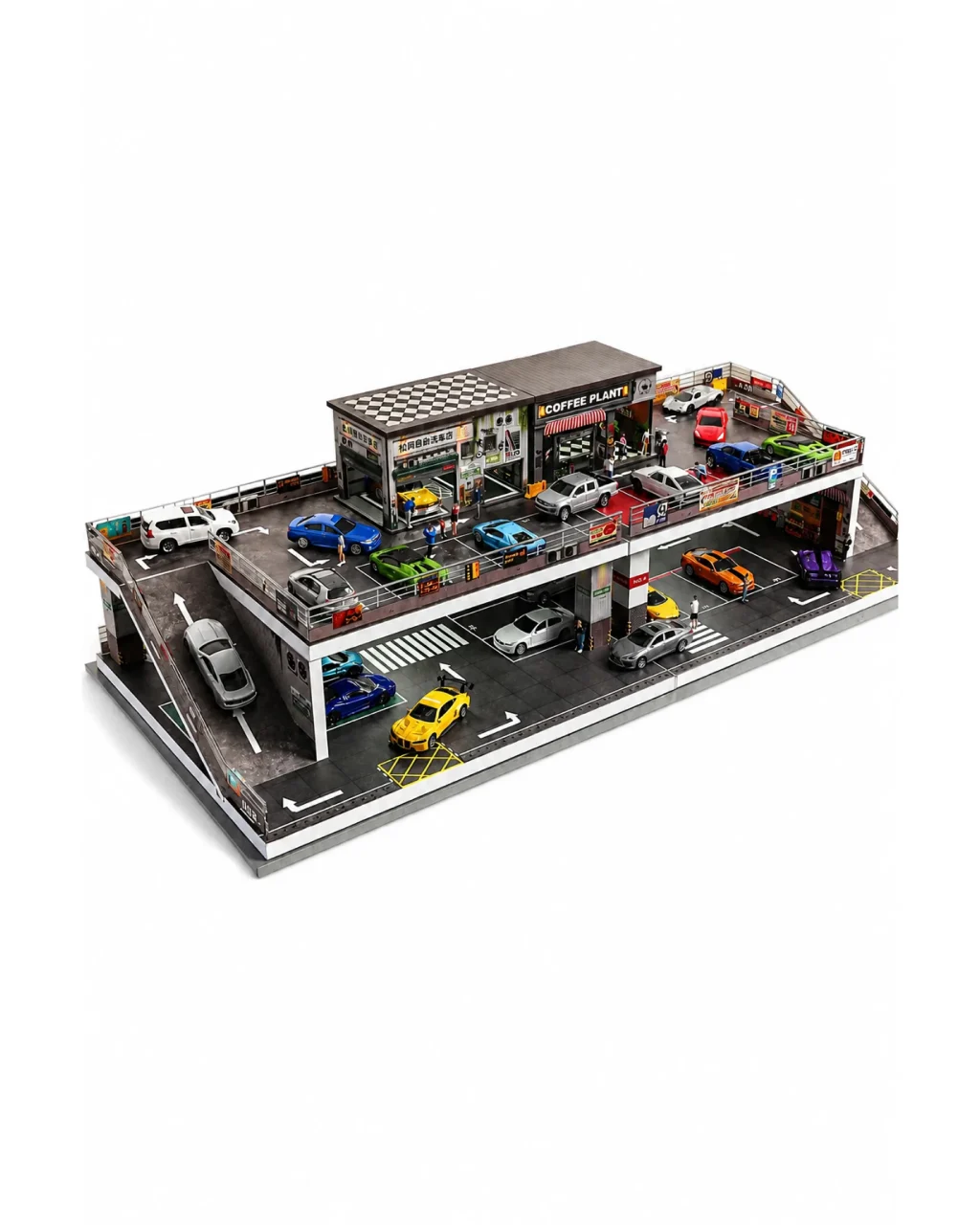
The Industrial Double-Level Parking (819) at 40 x 22 x 16.2 cm is the other option, and it has the most floor length of any scene in the range at 40 cm — useful if you want the car sitting at an angle with a second vehicle behind it, which suits a long-tailed prototype because you can see the whole profile. What I would avoid is a storefront or street scene. A hybrid racer parked outside a convenience store looks like a mistake.
Sealed box, and the parts that will not survive a pocket
It arrives in a sealed colour box with printed box art, held in a moulded tray. There is no display case, no stand and no figure in the box. Check the mirrors, the front splitter lip and the wing endplates when you unpack it.
The limitation to be clear about is the interior. There is no opening panel anywhere on this casting — the canopy does not lift, nothing hinges, and the cockpit is a shallow dark tub under tinted glass. From most angles you see a suggestion of a seat and a shadow. The real car's canopy is a big, obvious feature and this model does not give you anything to look at through it. If you buy models partly for the interior, this is not the one.
Two smaller notes. The carbon-effect surfaces are printed or moulded texture rather than actual weave, so at close range they read as a fine pattern rather than individual fibres. And the angular wrap has many edges meeting at sharp angles; where two printed colours butt up against each other on a curved panel, you can find the odd place where the join is softer than it is on a flat surface.
Specifications
| Specification | Value |
|---|---|
| Scale | 1/64 |
| Model type | Static diecast model car |
| Manufacturer | MINI GT |
| Packaging | Sealed Color Box Packaging |
| Product type | 1/64 diecast model car |
| Dimensions | 6–7 cm long (1/64 scale) |
| Weight | Approx. 90–120 g (with retail box) |
| Weight (loose) | Approx. 44–75 g (loose car) |
| Packaging size | Retail box approx. 10 × 4.5 × 3.5 cm |
| Spec note | Figures are approximate, measured from the manufacturer's posted packaging size and retailer weight data. They will be replaced with values from a physical parcel once stock ships. |
| Category | Cars |
Included / Not included
- Included: MINI GT BMW V8 GTP #1241 1/64 Diecast Model in Sealed Color Box Packaging.
- Not included: Display case and figures. These must be purchased separately.
Gift Angle
This is a present for someone who watches endurance racing and can tell a hybrid prototype from a GT car at a glance. It is also a strong choice for anyone who likes modern motorsport design as an object — the low canopy, the long tail, the exposed carbon. The angular wrap makes it visually busy in a good way.
What people react to is the tail. They pick it up, look at the front, then turn it over and find that the car simply ends in a flat, squared-off wall under a wing on two posts. That is not a shape anybody expects from a car.
Shipping & duties
Ships in 7–14 business days via tracked international shipping. Import duty is prepaid at checkout for the United States, the European Union, Turkey and Indonesia, so nothing further is due at delivery for those destinations; all other destinations ship duty-unpaid. Read the full shipping guide →
Frequently asked questions
Is the carbon finish real carbon fibre?
No. It is a moulded and printed carbon-effect texture applied to represent the bare composite panels of the real car. It reads as a fine woven pattern rather than individual fibres.
Does anything open on the model?
No. Every panel is fixed, the canopy does not lift and the wheels do not steer. The wheels roll, and that is the only movement.
Can you see the cockpit through the canopy?
Only in outline. The glass is tinted and the interior is a shallow, dark tub, so you get a suggestion of a cockpit rather than a detailed one.
How long is it compared with other 1/64 models?
It is 1/64 scale, so roughly 7 cm long. That is in line with other true 1/64 castings, which generally run between about 6.8 cm and 7.4 cm.
What comes in the box?
The model in a sealed colour box with printed artwork. No display case, no stand and no figure — those are separate purchases.
Is it safe for children?
No. It is a static diecast display model for ages 14 and over. Thin parts such as the mirrors and wing endplates can break under rough handling.
Similar products
Pair this model with other 1/64-scale models from the Collector Series to build a full miniature city on your desktop.

// Prices shown in USD. Shipping and duties are confirmed at checkout.