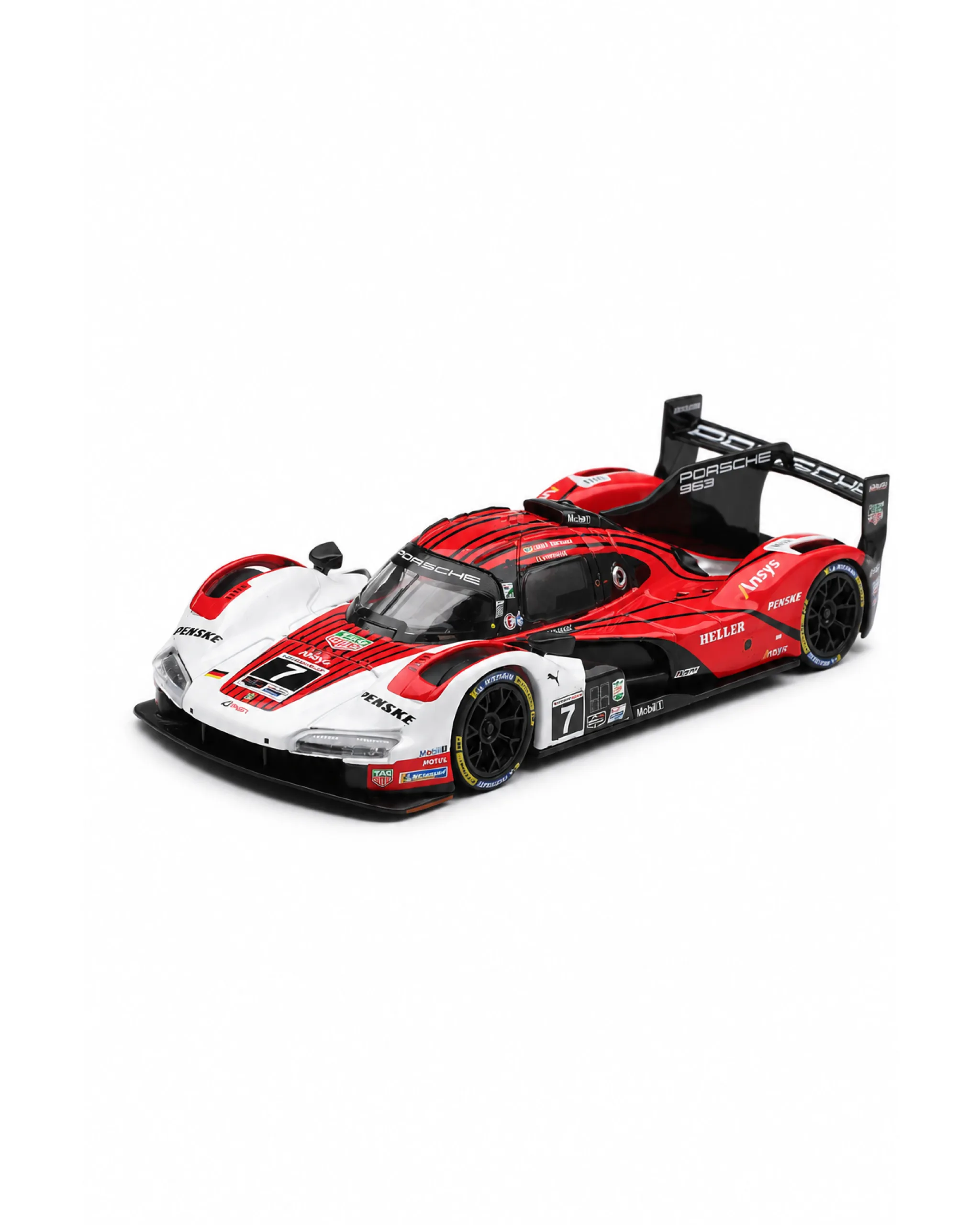
 Main view
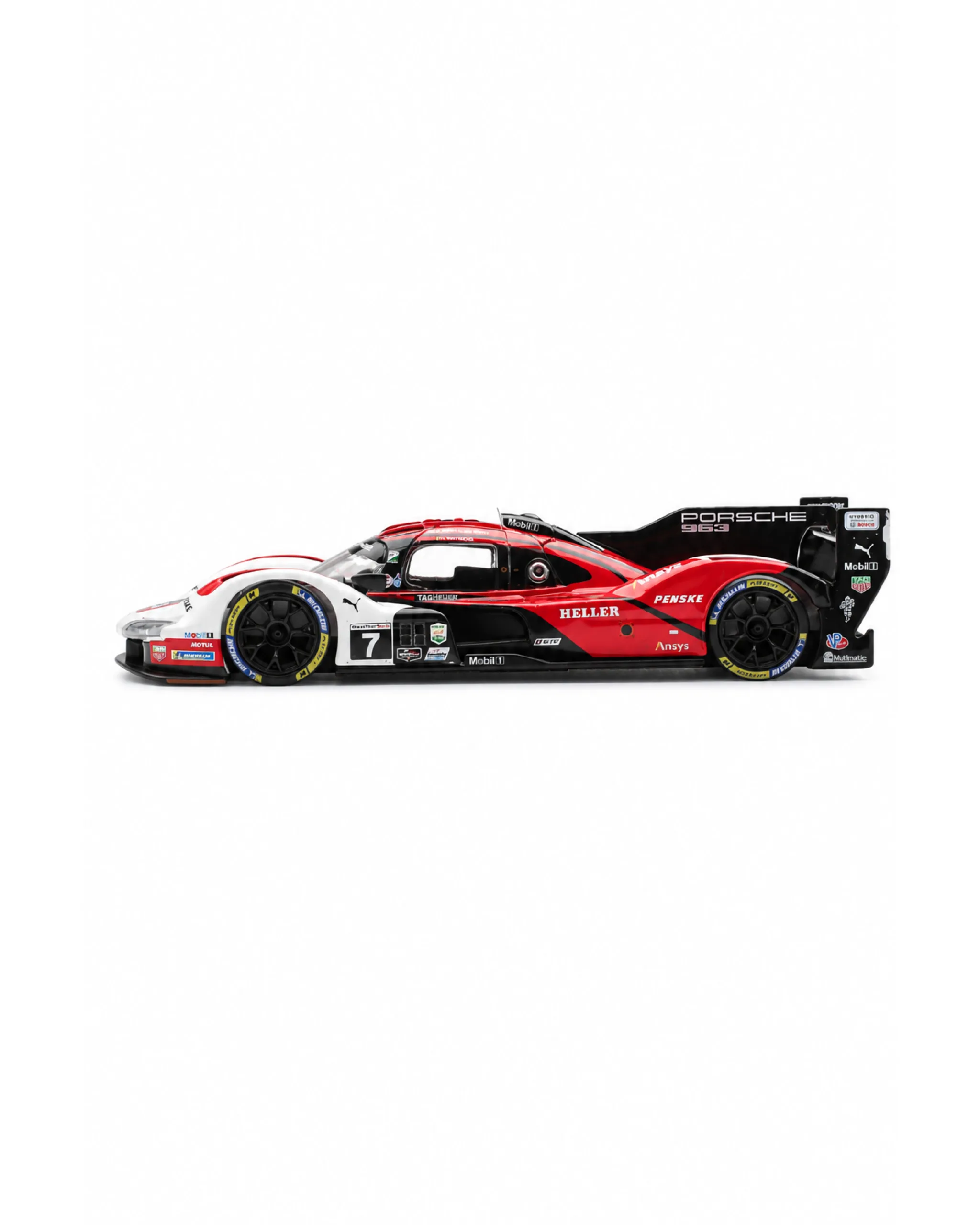 Angle 2
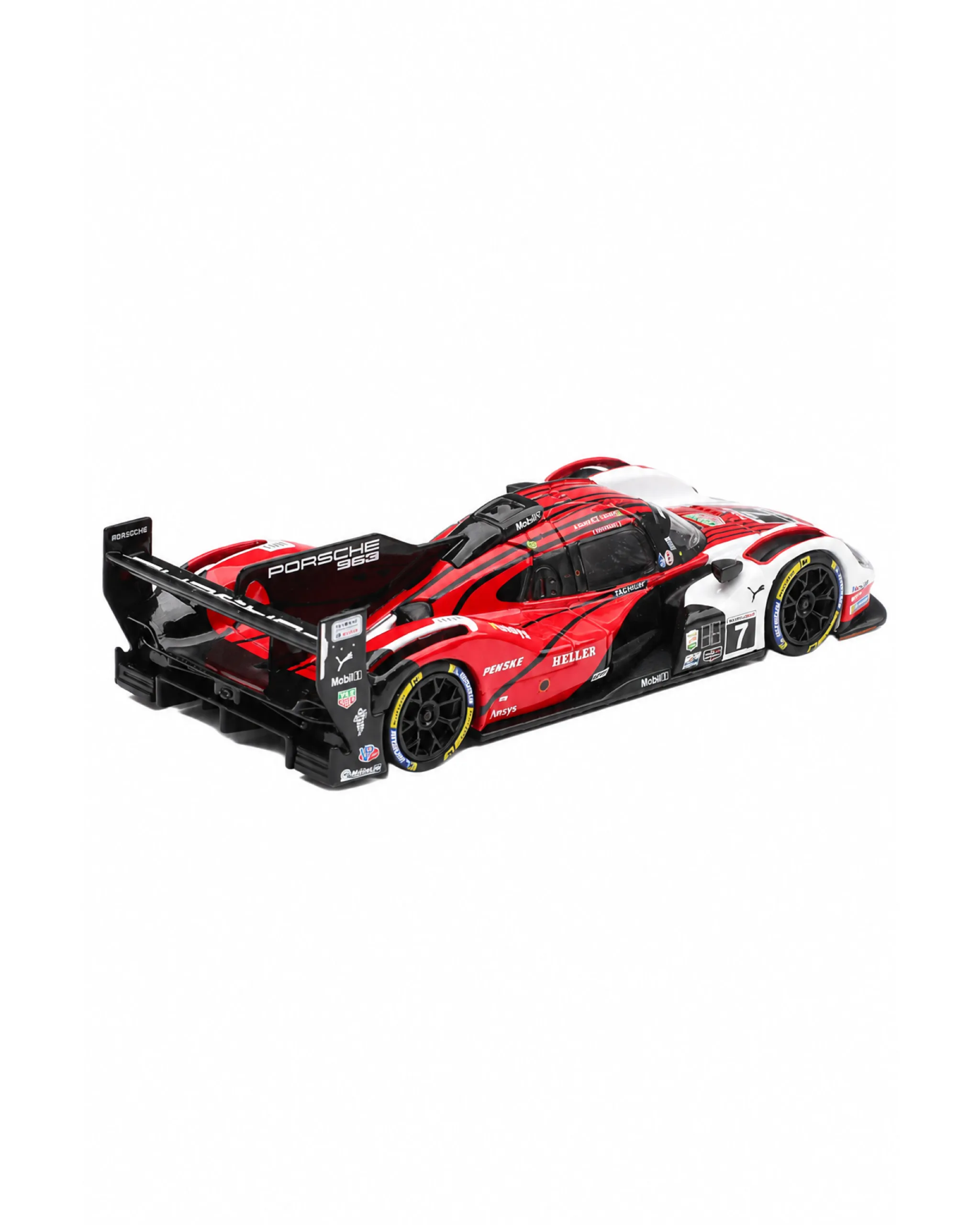 Angle 3
MINI GT Porsche 963 #1224 1/64 Diecast Model
A red-and-white 1/64 MINI GT Porsche 963 prototype, roughly 7 cm long with a two-element rear wing, a static diecast model for 1/64 pit and garage scenes.
At 1/64 the model measures roughly 7.2 cm end to end, counting the rear wing overhang, and about 2 cm to the top of the wing's endplates. The real car is around 5 m, so the arithmetic lands close. It is a static diecast model with fixed panels and rolling wheels. There is nothing to open.
Available from NXSTUDIO — an independent retailer of 1/64 diecast model cars from established brands, with full product specifications, protective packaging, and tracked worldwide shipping.
About this model
Prototype sports cars are the hardest thing to shrink, because their whole shape is a single continuous idea. There is no separate bonnet to break up the front, no cabin sitting on top of a body — the nose, the canopy and the long tail are one surface that rises and falls without a seam. When you scale that down to something you can hold between two fingers, the proportions have to be right or the whole thing collapses into a wedge. This Porsche 963 casting keeps its shape, and the photos show why: the canopy sits forward of centre, the deck behind it is genuinely long, and the wing towers above the tail on two tall supports.
At 1/64 the model measures roughly 7.2 cm end to end, counting the rear wing overhang, and about 2 cm to the top of the wing's endplates. The real car is around 5 m, so the arithmetic lands close. It is a static diecast model with fixed panels and rolling wheels. There is nothing to open.
A red and white car with a black roof scoop
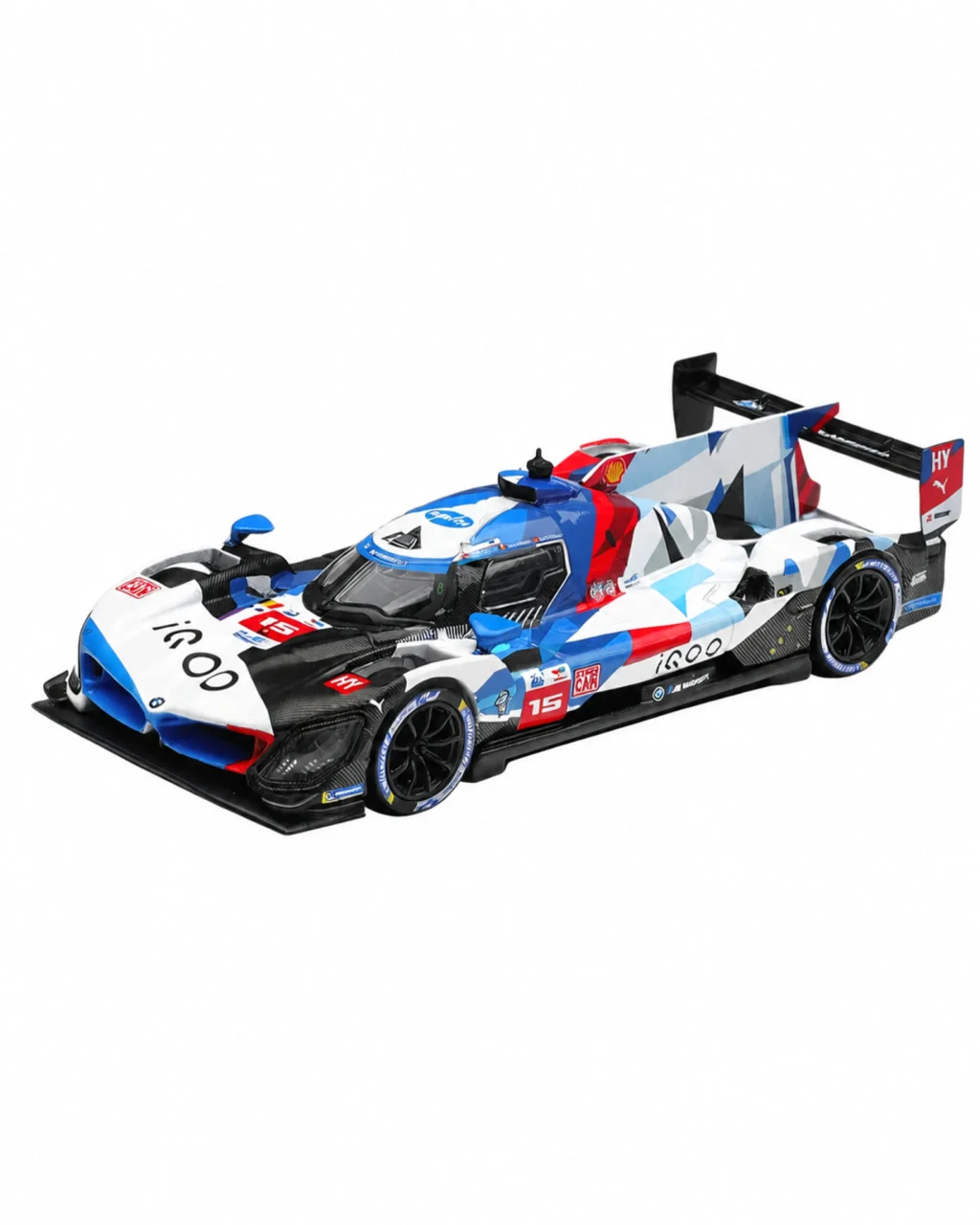
The body is a hard two-tone split, and the photos make the layout clear. White covers the front of the nose and the lower bodywork along the flanks. Red takes the canopy surround, the shoulders, the rear deck and the flanks above the black side skirt. Black is used structurally: a roof-mounted air scoop above the canopy, a black band across the nose, black wheel arches, black mirror pods, a black rear diffuser and the black wing assembly. Sitting between the red bodywork and the black roof there is a fine black pinstripe pattern running lengthwise, which is the sort of detail that only appears when you look closely at the deck.
The number seven appears twice, on the nose and on the door panel, in white on a dark square. The tyres carry printed sidewall markings, and the wheel rims are a dark multi-spoke design with a bright accent ring around the outer edge — that ring is a nice piece of work, because it separates the tyre from the rim at a size where the two would otherwise merge into one black circle.
The aero furniture is where this casting lives or dies
Everything that makes a 963 look like a 963 is thin and hanging in the air. The rear wing is a two-element design on twin swan-neck supports, with vertical endplates at each tip carrying small printed marks. The front of the car has a wide, flat splitter and dive planes on the outer corners. Along the sides there are turning vanes ahead of the rear wheels, and the rear has a diffuser with vertical strakes.
Reproducing those parts in diecast means the model maker has to cast shapes that are, in real terms, a few millimetres thick and then get them to sit square. On this model the wing sits level, the supports are upright and the endplates are parallel. That is not a given — it is the thing you check first on any prototype casting, because a wing that has gone in slightly twisted is very hard to unsee once you have noticed it.
Wide, flat decks and what they do to light
A GTP car is mostly large, gently curved panels, and that has a practical consequence on a shelf. There is very little bodywork to cast a shadow, so the model depends on the shape of the surfaces themselves to look like anything. The long red deck behind the canopy, the white nose and the black roof scoop all catch light at different angles, which is what makes the car read as a solid object rather than a silhouette. The high-gloss paint does most of the work here: on the red deck you can see a clean reflected highlight running the length of the car, and the transition from the white nose into the red shoulder shows as a soft gradient rather than a hard edge.
A pit box or a garage bay
Endurance prototypes want a pit lane or a garage, and the Container Auto Repair Garage (598) at 29.7 x 19.7 x 14.5 cm suits it well. A 7.2 cm car takes up roughly a quarter of the 29.7 cm width, which leaves believable room for a second car. The 14.5 cm height is the useful number: the wing is the model's highest point, and you want clearance above it.
If you prefer a longer, busier setting, the Industrial Double-Level Parking (819) at 40 x 22 x 16.2 cm gives you the most floor length of the parking scenes.
What is in the box, and what to be careful with
It arrives in a sealed colour box with printed artwork, held in a moulded tray. No display case, no stand, no figure. Check the mirrors, the front splitter lip and the wing endplates when you unpack it, because they stick out furthest from the body.
Here is the real limitation. The wing endplates, the wing supports, the dive planes and the mirror pods are the thinnest pieces on the model, and they are the parts most likely to arrive slightly out of alignment. They are also the first things to bend or snap if the car is handled carelessly or pushed across a surface. Nothing on the car opens, so there is no mechanism to go wrong — but the same is true in reverse: there is no way to appreciate the inside of this car. The canopy glass is dark and the interior underneath it is a shallow, mostly shadowed tub. You get a suggestion of a cockpit, not a cockpit. If looking into the cabin is part of why you buy a model, this casting will not satisfy that.
One more small thing. The printed numbers and the tiny marks on the wing endplates are, by their nature, at the very edge of what printing can resolve. They read as shapes rather than text.
Specifications
| Specification | Value |
|---|---|
| Scale | 1/64 |
| Model type | Static diecast model car |
| Manufacturer | MINI GT |
| Packaging | Sealed Color Box Packaging |
| Product type | 1/64 diecast model car |
| Dimensions | 6–7 cm long (1/64 scale) |
| Weight | Approx. 90–120 g (with retail box) |
| Weight (loose) | Approx. 44–75 g (loose car) |
| Packaging size | Retail box approx. 10 × 4.5 × 3.5 cm |
| Spec note | Figures are approximate, measured from the manufacturer's posted packaging size and retailer weight data. They will be replaced with values from a physical parcel once stock ships. |
| Category | Cars |
Included / Not included
- Included: MINI GT Porsche 963 #1224 1/64 Diecast Model in Sealed Color Box Packaging.
- Not included: Display case and figures. These must be purchased separately.
Gift Angle
This is a gift for somebody who follows endurance racing and knows what a 963 is without being told. It is also a good present for the person who likes modern prototype design for its own sake — the low canopy, the long tail, the wing — even if they do not follow the racing. The red and white scheme is bold enough to work as a desk object for someone who would never buy a model car for themselves.
What makes it land is the wing. People who are not collectors tend to pick up a small car and turn it over; on this one they get to the rear end and find a wing on tall supports with a diffuser underneath. That level of structure on something 7 cm long is what surprises people.
Shipping & duties
Ships in 7–14 business days via tracked international shipping. Import duty is prepaid at checkout for the United States, the European Union, Turkey and Indonesia, so nothing further is due at delivery for those destinations; all other destinations ship duty-unpaid. Read the full shipping guide →
Frequently asked questions
How long is the model?
It is 1/64 scale, so roughly 7 cm long including the rear wing overhang, and about 2 cm tall at the wing. The real car is around 5 m, which is where that figure comes from.
Is the rear wing plastic or metal?
The wing is a separate moulded assembly rather than part of the body casting, and it is thin. It sits level on the model in the photos, but it is the part to check on arrival and to protect afterwards.
Does the canopy or any panel open?
No. Everything is fixed. The wheels roll, but nothing steers and no panel lifts, so the interior is only visible through the dark canopy glass.
Can you see inside the cockpit?
Barely. The glass is dark and the interior is a shallow, shadowed tub. You can make out a suggestion of a cockpit but not a detailed one.
Is there a display case in the box?
No. It comes in a sealed colour box with printed artwork. A clear case, a stand and figures are all sold separately.
Is it a toy for children?
No. It is a static diecast display model for ages 14 and over. The thin aero pieces in particular are not built to survive being played with.
Similar products
Pair this model with other 1/64-scale models from the Collector Series to build a full miniature city on your desktop.
// Prices shown in USD. Shipping and duties are confirmed at checkout.