“I don’t want anything” is the universal male response to gift questions. It isn’t a refusal, and it usually isn’t modesty either. Translation: he hasn’t thought about it, and he’d rather not feel like he owes someone a thank-you for something he didn’t ask for.
There’s a second layer that most gift guides skip. Almost every guy does have a short list of things he’d genuinely enjoy, but none of them survive the test of “is this worth asking another person to spend money on.” A thing he wants is a thing he feels he should buy himself, so the moment someone asks, every candidate gets quietly filtered out as too expensive, too silly, or too hard to explain out loud. That’s why “I don’t want anything” really means “I haven’t thought about it, and I’m not going to solve it in the next ten seconds” — you have to do the thinking for him. The gifts that land are the ones he’d never put on a list: either genuinely practical, or the kind of thing that makes him say “wait, this is actually really cool” — an object he’d never buy himself because it sounds like a waste of money until it’s sitting on his desk.
Here are eight ideas for the second kind. They lean toward what we sell and handle every day — 1/64 scale cars and diorama scenes — but the list also covers the desk, the shelf and the weekend, because not every guy wants a model.
The short version (if you’re buying today)
If he already owns a few diecast cars, a 1/64 diorama scene is the most reliable reaction-getter here. It turns a row of little cars into an actual place, and it costs less than a decent pair of headphones. Across the counter, the scenes and single cars are what we see people buy for gifts more than anything else — and they’re the ones people actually keep, rather than the ones that get politely shelved. If he owns no cars at all, start with one car and one small scene. Budget $40–90 and expect a packed scene to weigh over a kilo.
| Budget | Who it’s for | What to buy | Why it works |
|---|---|---|---|
| $40–55 | The guy with no collection yet | One 1/64 car (Mini GT or Inno64) plus a small scene | Lowest risk, nothing to assemble, he can build on it himself |
| $45–65 | The desk guy | Ramen shop or convenience store scene, 29.5 x 19.8 x 16 cm | Fits on any desk, instantly starts conversations |
| $55–80 | The guy with cars but no shelf plan | Double-level parking garage, 29.7 x 20 x 11 cm | Doubles as a display case, every new car gets a bay |
| $60–90 | The guy who says he doesn’t need a hobby | Bigger scene (izakaya or parking lot) plus one hero car | Makes it a hobby rather than a knick-knack |

1. A tiny Japanese street scene on his desk
You’ve probably seen these — a miniature ramen stand, a convenience store, a parking garage, all roughly the size of a hardcover book. They’re genuine 1/64 scale, built from plastic, resin and fiberboard rather than printed cardboard, and they sit on a shelf or desk without taking over the room. The ramen shop we stock most often measures 29.5 x 19.8 x 16 cm and weighs about 1.3 kg, which is the difference between “toy” and “object with presence.”
What’s in the box: the finished scene, sealed in a colour box, zero assembly, no cars and no figures. Some pieces have lit signage that runs off a small electronic pack. It lands because it starts conversations, and because most guys would never buy it for themselves — it sounds like decoration until it’s in front of them.
What could go wrong: it’s bigger than people expect. At almost 30 cm across it needs a real desk or a shelf with depth, and it will not sit on a narrow floating ledge. Buy a printed backdrop instead and it arrives flat, looks flat, and he’ll know within a second.

2. A well-packaged 1/64 scale car
Mini GT, Inno64, Tarmac Works and Kaido House make small models that are genuinely impressive in hand — the paint, the wheel fitment, the proportions. True 1/64 cars run 6.8–7.4 cm long and under 2.2 cm tall, and they arrive in a sealed colour box with the casting printed on the front. Expect roughly $22–40 depending on the casting, which makes this the affordable half of a two-part gift.
Pick a casting with a story: a Porsche 911, a Skyline R34, a Toyota AE86, or whatever matches the car he actually drives. That’s also the honest answer to why anyone buys cars at all: a real one is out of reach, a seven-centimetre version isn’t. One right box beats three random ones.
What could go wrong: paying two or three times retail on a resale listing for a hot livery, which happens constantly. Also worth knowing that Hot Wheels mainline cars are roughly 1/62–1/68 depending on the casting, so they sit a little taller next to true 1/64 models — fine on an open shelf, but check bay height before buying an enclosed building.
3. The display that makes a shelf look intentional
Five 1/64 cars lined up on a bare shelf looks like stock. The same five cars inside a multi-level parking garage looks like a collection, because the scene gives the cars somewhere to be. The double-level parking workshop is 29.7 x 20 x 11 cm and parks several cars in individual bays; the windowed multi-storey garage is 35.5 x 18.5 x 22.7 cm if you want something with real height.
This is the pick for the guy who already owns cars and keeps them in a shoebox. It solves a problem he hasn’t admitted he has, and it keeps working — every new car he buys has a place to park. Roughly $45–70 for the compact versions, $70–90 for the tall ones.
What could go wrong: scale drift. A scene listed as 1/64 fits true 1/64 cars, but a “fits all scales” listing usually fits none of them properly. Remember too that cars and figures are sold separately — a garage arrives empty, so pair it with one car if he owns nothing yet.
4. A Japanese stationery set with actual character
Not the generic leather notebook that shows up on every gift list. Japanese stationery — Pilot pens, Midori notebooks, Tombow markers — has a distinctive look and feel that’s hard to describe until you hold it, and the jump over standard office supplies is obvious within five seconds. A starter set of a fountain pen, two notebooks and a couple of markers runs $30–50 and almost never goes unused.
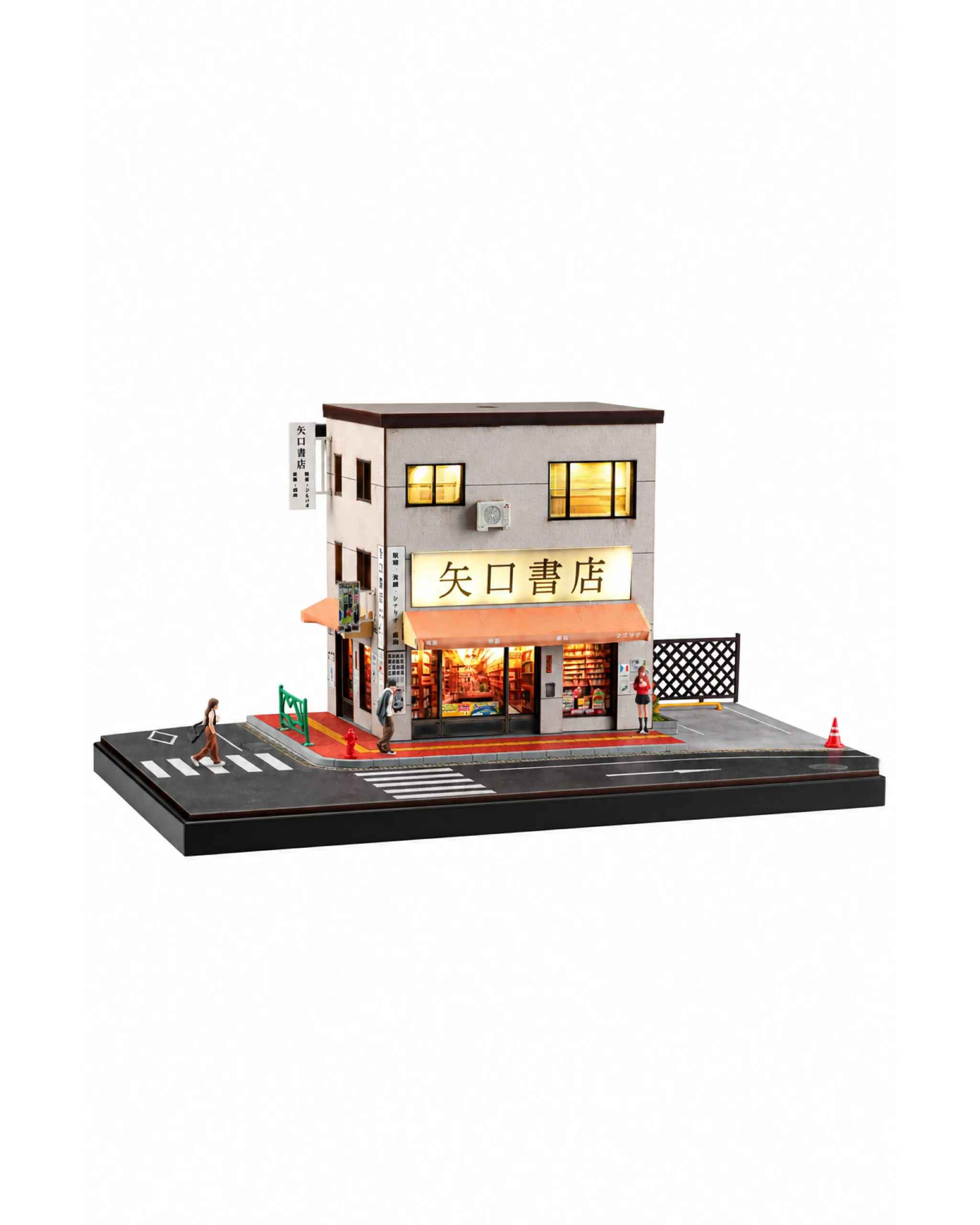
The bookstore micro-scene is the natural companion: 29.5 x 19.8 x 14.2 cm, and it looks right sitting beside actual books on an actual shelf. It’s also the pick for the quieter collector whose taste runs more to calm than to neon.
What could go wrong: giving good stationery to someone who doesn’t write anything down. If his notes all live in his phone, skip this one.
5–8. The rest of the list
These four aren’t models, and that’s deliberate — a list where everything comes from one category reads like an advert.
- A desk lamp that’s not boring. If his lamp is a beige cone from the 1990s, replacing it changes the entire desk. Look for USB-C power, adjustable colour temperature, and a head that actually aims where he’s working. $35–70 buys a good one; the very cheap ones flicker and the plastic yellows inside a year.
- The headphone stand he didn’t know he needed. If he wears headphones at a desk, this is the classic “I would never buy this for myself but I use it every day” gift. Wood or metal, $40–80 from makers like Grovemade or Oakywood. Measure the base width first — a heavy planar magnetic headphone will tip a narrow stand.
- A real book about cars, not a coffee table book. Skip the glossy “supercars of the world” volume nobody reads past page 20. Get Enzo Ferrari by Brock Yates, a proper racing history, or a technical guide to the car he actually owns. $20–35, and it outlasts everything else on this page.
- A weekend driving experience. Not a racing school and not a tourist supercar day. Rent something interesting, plan a route with real corners, and make a full day of it. $150–400 depending on the car, so it’s the one to split between a few people — and the only gift here he’ll still be describing five years later.
What to actually avoid
Straight list, so you don’t waste the money:
- Generic acrylic display cubes. The cars rattle around, it reads as storage rather than a scene, and most aren’t true 1/64 — so the cars look either lost or wedged in.
- Anything listed as “fits all scales.” It doesn’t. If he collects 1/64, buy 1/64 scenes specifically.
- Printed cardboard backdrops. They photograph well and arrive creased, and in person they have no depth at all.
- Resale listings for limited liveries. Three times retail isn’t a gift, it’s a donation. Smaller shops get the same stock at normal prices.
- Anything sold as “assembly required” with loose parts. Manufacturer scenes arrive ready to display; a box of loose corners is a broken corner waiting to happen in transit.
Why toys, why cars, why scenes
People ask us this constantly, usually while insisting the question is about a nephew. The honest answer is that a lot of adults are buying back something from being a kid with no money. The cars you wanted at eight are the cars you can afford at thirty-five, and nobody calls it childish when it’s sitting on your own desk.
Cars also solve a very direct problem, which is that most of us will never own the real thing. A 1/64 model is the cheapest and smallest way to own a shape you like — seven centimetres of metal on a shelf instead of a garage you can’t afford. Scenes answer the question a car alone can’t. One car on a desk is a toy; a car parked outside a lit ramen shop is a place. That’s why we stock scenes as heavily as we stock cars: a row of cars with no scene is an inventory list, and a scene gives the collection somewhere to live.
Why buy from a shop that only does 1/64
The practical difference is packaging. A $60 scene with tiny awnings and printed signage is fragile, and it still has to survive a courier. We ship scenes double-boxed with foam corner protection. A marketplace seller who puts one in a padded envelope is gambling with your gift, and a crushed awning isn’t something you can fix with tape.
The second difference is scale accuracy and price. We only sell 1/64, so the dimensions on a product page are the ones we measured on the actual piece — 29.5 x 19.8 x 16 cm, 1.3 kg — not a rounded guess copied from a supplier catalogue. Buying direct also means shop price rather than resale markup. A big marketplace is fine for a headphone stand; for a fragile scale scene it’s the wrong tool.
Frequently asked questions
Do the scenes come with cars or figures?
No. Scenes ship empty so collectors can place their own cars, and figures are sold separately as well. It’s how the line is built, not a shortcut. If the person doesn’t own any 1/64 cars yet, pair the scene with one Mini GT or Kaido House model and the gift works straight away.
Will a scene fit the cars he already owns?
If he collects Mini GT, Inno64, Tarmac Works or Kaido House, yes — those are true 1/64 at 6.8–7.4 cm long and under 2.2 cm tall, and the scenes are built to those numbers. Hot Wheels mainlines are closer to 1/62–1/68 depending on the casting, so they sit slightly larger. They work fine in open parking scenes, but check the roof height before buying an enclosed garage or workshop.
How much space does one of these actually take up?
Most single-storefront scenes measure around 29.5–29.7 cm long and 19–20 cm deep, roughly the footprint of a hardcover book lying down, with 11–16 cm of height for the signage. The big multi-storey garages reach 35–40 cm across, which needs a dedicated shelf rather than a corner of a desk. Check the listed dimensions before buying — nothing here is phone-sized.
Why not just buy a toy car from a big retailer?
You can, and for a Hot Wheels mainline it’s a fine two-dollar answer. The difference is what happens after. Retail toys come in blister packs with no display purpose, while a boxed 1/64 model and a scene are made to be kept out and looked at. If the gift is meant to say “I noticed what you’re into,” the packaging and the scale accuracy are most of the message.
The honest approach: skip the novelty mug and the “best dad ever” socks. Pick one thing that matches what he actually does with his weekends, buy it somewhere that packs it properly, and let the object do the talking.