If you’ve ever gone down the rabbit hole of 1/64 scale dioramas — specifically the tiny Japanese street scenes that look like miniature Ghibli stills — you’ve probably come across Shou Cang Jia (收藏家). They’re the ones behind that ramen shop, the Lawson storefront, the corner izakaya that keeps popping up in collector setups.

Who are they, actually?
Shou Cang Jia literally translates to “Collector” or “Collector’s Family” in Chinese. They’re a small Chinese manufacturer — not a big company with a marketing team, more like a workshop that does one thing extremely well: making detailed 1/64 Japanese micro-scenes.
Their range is focused. No diecast cars (that’s someone else’s job), no figures, no LED kits. Just the scenes — and every piece carries a level of architectural detail that makes the scenes look like they belong in a museum case, not a toy box.
We stock the line at NXSTUDIO, which means we handle these boxes constantly — receiving them, measuring them, repacking them, and opening one to photograph a listing or check a shipment before it ships out. Most of what follows was written from the shelf, not from a press release. Cars and figures are sold separately, and that’s the first thing to understand before you plan a scene.

The materials
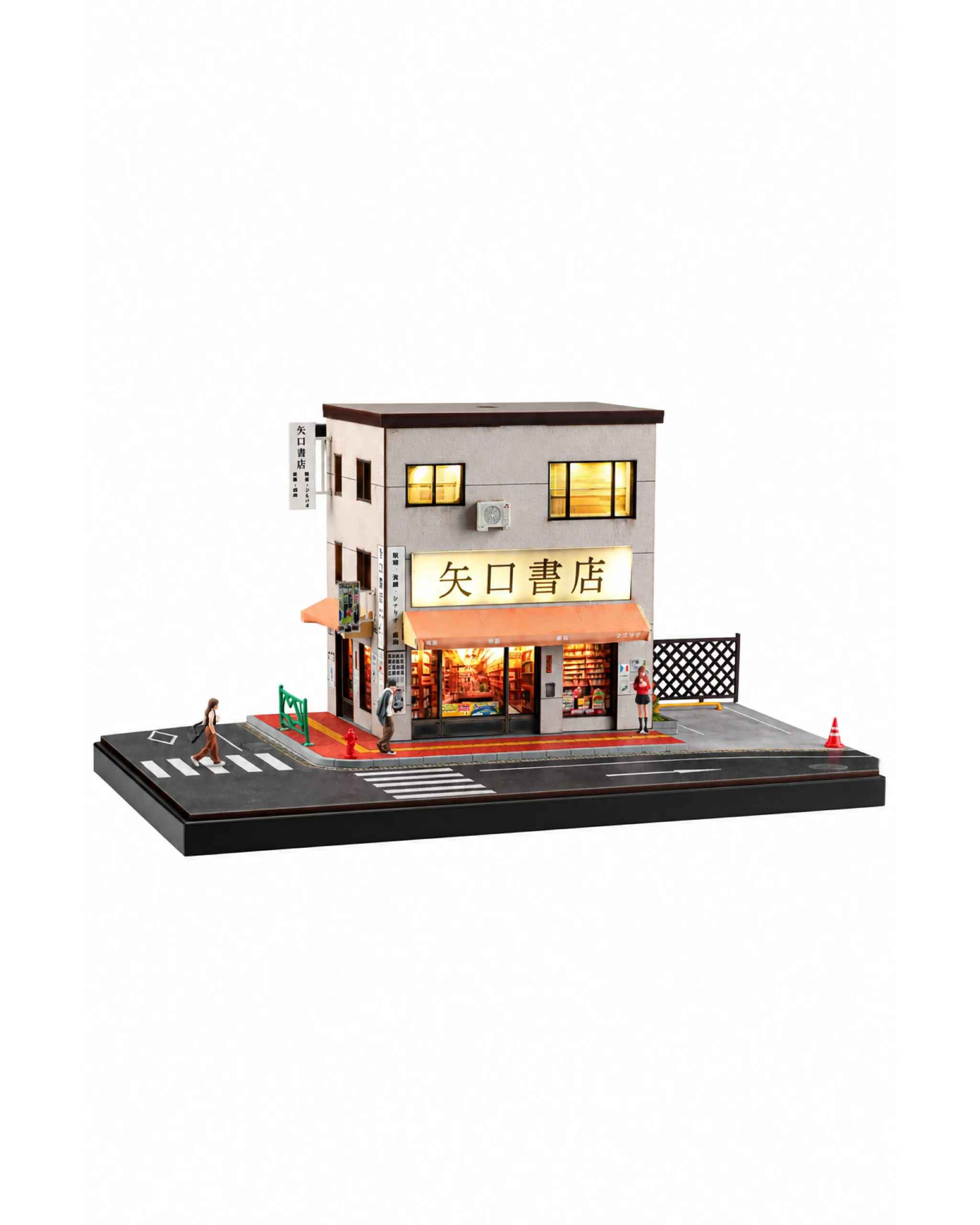
They use a mix of plastic, resin and fiberboard — not 3D-printed, not printed cardboard. The walls have actual texture, the signs have real lettering, and the surfaces catch light like real materials. Some scenes have functional tiny doors or partitions.
This matters because when people compare Shou Cang Jia scenes to cheaper alternatives (usually thin plastic or all-cardboard), the difference is immediate. The cheap ones look like a model kit from a dollar store. Shou Cang Jia scenes look like something that belongs behind glass.
Why the weight number matters more than the photos
Here’s a test anyone can run on a listing page before buying: look at the shipping weight. The Lawson Convenience Store weighs 847 g. The Japanese Ramen Shop weighs 1.3 kg. Those are real figures from our own listings, and they tell you more about a diorama than any product photo will.
A hollow shell of printed board with a sticker facade can look convincing in a studio photo. It cannot weigh 1.3 kg at 29.5 x 19.8 x 16 cm without actual material in it — resin castings, dense fiberboard bases, and in some pieces electronic components behind the signwork and interior lighting. Pick the ramen shop up and the mass sits low in the base; it doesn’t flex or creak.
Weight also predicts how a scene survives. Thin acrylic and card scenes arrive with stress marks at the corners and warp slightly in a warm room. The heavier pieces hold their geometry. The honest caveat: weight makes shipping more expensive, and a 1.3 kg scene in a big box is not a cheap parcel. That cost is materials, not markup.
The range
Most of the line is Japanese street culture: convenience stores (Lawson, 7-Eleven style), ramen shops and izakayas, bookstores and stationery shops, parking structures (multi-level, industrial), bus stops and stations, corner shops and old warehouses.
They’re all true 1/64 scale — the buildings, the clearances, the proportions all line up with Mini GT, Inno64, Tarmac Works and other 1/64 diecast collections. They’re not “roughly 1/64” — they’re precisely sized for the scale. A true 1/64 car runs 6.8–7.4 cm long and sits under 2.2 cm tall, and that’s the number the doorways, garage bays and shop interiors are built around.
The range in real numbers
Not every scene is the same footprint. The line splits into three practical sizes: a compact 20 cm group, a standard 29–30 cm group where most street scenes live, and a large 35–40 cm group for parking structures. Here are eight examples with the exact dimensions from our product pages.
| Scene | Category | Dimensions (cm) | Footprint note |
|---|---|---|---|
| Japanese Ramen Shop | Storefront | 29.5 x 19.8 x 16 | Tallest of the standard street pieces; 1.3 kg in hand |
| Lawson Convenience Store | Storefront | 29.7 x 20 x 11 | Wide, low frontage; 847 g |
| Japanese Train Station | Storefront / street | 29.5 x 20 x 13.5 | Pairs with the bus station below |
| Bus Station | Storefront / street | 19.7 x 10 x 10 | Compact half-depth piece, good on a shelf edge |
| Double-Level Parking Workshop | Parking / industrial | 29.5 x 19.8 x 12 | Fits 4–6 cars across two levels |
| Japanese Slope Parking Lot | Parking / industrial | 40.5 x 30 x 22 | Largest footprint in the line; needs a real table |
| Windowed Multi-Story Parking Garage | Parking / industrial | 35.5 x 18.5 x 22.7 | Narrow and tall — good against a wall |
| Industrial Warehouse | Parking / industrial | 29.5 x 19.7 x 20.5 | Tall standard footprint, generous interior height |
The compact group is where most people start, because 19.7 x 10 x 10 cm fits on a desk next to a keyboard. The standard 29–30 cm group is the heart of the line and the reason these scenes read as streets rather than shelves. The 35–40 cm parking structures are a commitment: the slope lot is 40.5 x 30 cm, roughly an A3 sheet of paper, and the slope lot 2 is 40.2 x 30.2 x 22.2 cm — near-identical, so don’t buy both expecting two different buildings.
Height is the spec nobody checks
Length and width get all the attention, but height decides what actually goes inside. An open slope parking lot is forgiving. A closed garage with a roof beam is not, and we’ve had customers discover that after delivery. Our rule of thumb: Mini GT, Inno64, Tarmac Works and Kaido House at 6.8–7.4 cm long and under 2.2 cm tall go anywhere in the line. Hot Wheels mainline runs closer to 1/62–1/68 and can reach 2.4 cm, so it’s fine in open lots and needs a clearance check under a roof.

Why you can’t buy them on Amazon
Here’s the thing: Shou Cang Jia scenes aren’t available on Amazon. The workshop is small, they don’t do marketplace arbitrage, and the pricing stays at factory-direct levels — roughly $30–75 per scene depending on size and complexity.
They’re available through specialist diecast retailers (NXSTUDIO is one of the main ones), and the fact that they’re not on Amazon is actually part of why they stay good. No scalper markup, no “fits all scales” mislabeling, no soft mailers that arrive with acrylic panels cracked.
It’s worth being concrete about what “not on Amazon” buys you. A marketplace seller listing a niche item has to price in platform fees and ad spend, and the standard fulfilment route is a soft plastic bag or a thin single-wall carton — exactly the wrong packaging for a 1.3 kg scene with thin architectural parts. That’s how a “new in box” listing arrives with a snapped railing. We ship these in a double-wall box with the factory color box protected inside it.
The second thing it buys you is scale honesty. On a general marketplace, one listing copy gets pasted across a dozen products and “1/64” becomes a keyword rather than a measurement. When a retailer only sells 1/64, a wrong scale claim comes back as a return they have to eat. The tradeoff is a smaller catalogue than a giant marketplace, and popular pieces go out of stock between workshop runs.
Shou Cang Jia vs the cheap alternatives
Most people comparing these scenes are choosing between three things: a Shou Cang Jia piece, a generic acrylic display box, and a printed cardboard backdrop. They solve different problems, and being clear about that saves money. The acrylic box protects cars from dust; it isn’t a scene. The cardboard backdrop photographs fine in a flat lay and fails in person.
| Shou Cang Jia scene | Generic acrylic display box | Printed cardboard backdrop | |
|---|---|---|---|
| Material | Plastic, resin and fiberboard; some pieces with electronic components for lighting | Cast acrylic panels, usually 2–3 mm | Coated card stock, printed flat |
| Scale accuracy | True 1/64 — built around a 6.8–7.4 cm car body | Scale-agnostic; sized to hold a box, not a car | Nominal; the printed car is whatever the file was |
| Weight | 847 g to 1.3 kg depending on piece | Typically 300–600 g for a comparable footprint | Often under 200 g; flexes under light pressure |
| Detail | Textured walls, real lettering, working doors and partitions on some pieces | None — you see the back of your own car | Printed on two or three faces; flat in raking light |
| Packaging | Sealed color box, shipped in a double-wall carton | Usually a soft mailer or single-wall carton | Envelope or thin flat pack, corners fold first |
| Cars and figures | Not included — sold separately | Not included, not needed | Not included, not possible |
| Best for | A display that reads as a place | Dust-free storage of carded and loose cars | Quick photography backgrounds |
None of the three is worthless. Plenty of collectors run an acrylic box for storage and one Shou Cang Jia scene for display, and that’s a sensible split. The mistake is buying a cardboard backdrop expecting the in-person presence of a resin and fiberboard building — the photos are the one area where the cheap option genuinely competes.

What it’s actually like in person
Honestly? Better than the photos. The packaging is a proper sealed color box (Shou Cang Jia includes one with every piece), and the scenes feel more substantial in hand than you’d expect from a “miniature.”
If you already collect 1/64 cars, you’ll notice they’re precisely scaled to match — cars actually sit in the garages, people actually stand on the sidewalks. If you don’t collect yet, these scenes are the reason a lot of people start buying the cars.
There’s a reason the scene often comes before the collection. A row of ten loose cars on a shelf is a lineup, and after a while your eye stops landing on any single one. Put three of those cars in front of a lit Lawson storefront and the same three read as a street at dusk. The scene gives the collection a place to be. Coming at it the other way, one scene, one car and one figure is already a complete display.
How to build a scene
Start with one piece (the corner izakaya or the ramen shop are the most popular first buys). Add a car (Mini GT or Inno64 work perfectly). Optional: add one or two 1/64 scale figures from G-Fans or MoreArt. The scenes look full and alive with just three or four pieces.
The multi-level parking scenes are a different vibe — less “Japanese street,” more “functional display.” If you have 4–6 cars, a parking garage diorama gives them a proper home without looking like you’re just lining them up on a shelf.
Order of operations when we unpack stock
Before anything goes on a shelf, the box gets opened and the piece inspected — rooflines, railings, glass and any lit components. A surprising share of damage in this hobby happens in transit rather than in the box, which is why the outer carton matters as much as the factory color box. Assembly is zero: it comes out and displays. My practical advice is to buy the scene before the cars, not after, and to measure your shelf first. A standard 29.5 x 19.8 cm piece needs about 30 x 20 cm of clear surface, and the slope lots at 40.5 x 30 cm will not fit a typical shelf edge.
The one-sentence verdict: if you’ve seen a “cute tiny Japanese street scene” on Instagram and wondered who makes them — it’s Shou Cang Jia, and they’re worth every penny for the detail alone.
Frequently asked questions
Why buy the scene instead of just more cars?
Because a lineup and a scene do different jobs. Cars alone sit in a row and your eye stops resolving individual models after the first few. A scene gives them context — a storefront, a garage, a station — and the same cars read as a street. If you already have five or six 1/64 models and they’ve stopped feeling like anything, a diorama is usually the missing piece rather than a seventh car.
Do the scenes come with cars or figures?
No. Every Shou Cang Jia piece is the building and the ground only — cars, figures and any external lighting are bought separately. That’s part of why the range can hold its detail at this price, because the workshop isn’t paying to bundle a mediocre car with a good building. Plan for one car and one or two 1/64 figures from G-Fans or MoreArt and the scene looks finished.
Will my cars actually fit?
Yes, if they’re true 1/64. Mini GT, Inno64, Tarmac Works and Kaido House run 6.8–7.4 cm long and under 2.2 cm tall, which passes everywhere in the line, including covered garages. Hot Wheels mainline is closer to 1/62–1/68 and can reach 2.4 cm, so it’s fine in open parking lots but worth checking against a closed garage roof.
Why are they only available from specialist retailers?
The workshop is small, doesn’t chase marketplace channels, and doesn’t run the discount-and-ad cycle a big platform listing requires. That keeps pricing at factory-direct levels — roughly $30–75 depending on size and complexity — and means nobody marks the same piece up because it ranks on a search page. The tradeoff is availability: runs are limited and popular pieces sell out.